No matter where you live, chances are you've got a couple of weeds you battle in your garden constantly. I don't mean weeds like the annoying yet manageable dandelion. I mean weeds that make an organic gardener want to reach for the roundup. I've got three. And I've listed them here in order of my hatred for them.
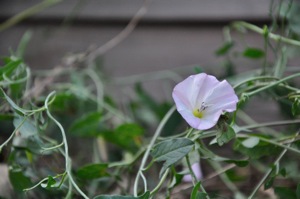 1.Bindweed, Convolvulus arvensis from the latin word convolere,"to entwine". This is a highly invasive perennial vine with very deep roots that wraps itself around the plant like an anaconda around its victim, eventually choking it out. In my garden, this weed grows in mulched flowerbeds, in the grass, between my patio pavers and sometimes even in containers. The only way to get rid of it is to continuously pull it out, never let the flowers go to seed, and try to deprive it of sunlight either by covering it with weed cloth, or shading it with plants. It's in the same family as morning glory. In fact, before I was warned by some blog readers, I once posted a picture of this stuff lamenting how beautiful it was out there bedazzling my boring backyard. If I could have seen all your faces when you read that post. I read somewhere that one plant can produce up to 500 seeds which can remain viable for 50 years. 50 Years! That basically means I will not get rid of this weed in my lifetime. Depressing. I've also seen a couple of sources which claim one of the nicknames of bindweed is creeping charlie. That is incorrect. Which brings me to my second most hated weed.
 2.Creeping Charlie, Glechoma hederacea is a low growing perennial weed brought to America by European settlers who used it medicinally. Sometimes called "ground ivy" or "creeping jenny", it prefers shade but will invade sunny areas where the lawn is thin. In my garden, areas of grass that I kept covered with dirt or tarps too long now contain nearly 100% creeping charlie because the grass died and it took over. In the spring, creeping charlie has little blue flowers that are quite pretty. But alas, once the blooms are finished, you're left with a weed that moves in mass creating a carpet of creeping charlie as it goes. The picture I've posted is the edge of my pie garden which I just installed last year. I am constantly cutting back the creeping charlie to prevent it from taking over this garden. Most of the sources I've reviewed say the best way to control creeping charlie is to maintain a healthy, weed free lawn. That may work for you, but it'll probably never happen in my garden. I have a feeling I'll be battling this one for a long time, too.
 3.Purslane, Portulaca oleracea is an annual succulent also referred to as "pigweed" or "little hogweed". It has smooth red stems which are quite pretty against the green leaves. To me, purslane is sort of like the terminator of weeds in that it can grow from a tiny piece that fell onto the ground during weeding. In that respect, it really does act like a succulent. In my garden, purslane only grows around the month of June. Don't get me wrong, it is very hardy, growing anywhere it can make contact with dirt (it doesn't grow in my grass like bindweed and creeping charlie) but as long as I keep yanking it out, I usually don't see it much past July. But right now my raised vegetable beds are being taken over by it and it's driving me crazy. It seems to really love the cotton burr compost I added this year because it's more aggressive now than any other year and that's the only thing I've done differently. The best way to get rid of purslane is to continue pulling it out, just like the bindweed. Purslane can be eaten just like a leaf vegetable in salads or stir frys and it contains more Omega-3 fatty acids than any other leafy vegetable. The nutritional value and culinary uses of purslane reach far outside the self imposed limit of this blog post, but I encourage you to read up on it, eat it, then report back to us on how it tasted.
Sitting here three years after I built my first garden and started this blog, I had to laugh at the naivety of discovering those three weeds.  I was excited.  I thought all three were pretty.  Now, bindweed gives me nightmares and fits of angst the entire summer.  Like one of those horror movies where my house is completely covered with a spider web and I'm trapped, only it's bindweed I'm trapped under.  Discovering those three weeds really changed the way I garden, too.  I no longer get excited when I see a new seedling has volunteered.  It's more like a couple of steps away from cautious optimism.  Now I wait and watch, always fighting myself on how long to give it before declaring it a flower or a weed and thereby deciding its fate in my garden.

What are the worst weeds you battle in your garden?


